White Mythology: A Novel by W.D. Clarke

Out today in trade paperback from corona\samizdat and available from their website

Edit: White Mythology is now also available in the followinng formats:

as an eBook (Kindle here and epub here, both via Redfiend Publishing in association with corona\samizdat)

and as an audiobook (link soon)

Synopsis: Dr. Ed’s head is spinning: a long-lost ‘son’ has just been sent over to his office by the temp agency, his shopping-addicted wife seems to have disappeared, and the clinical trial that he is running for a revolutionary new anti-depressant might well be going off the rails. But we needn’t worry about Dr. Ed: he is in control of everything, including himself.

Thus begins Skinner Boxed, the first of two thematically linked novellas that comprise White Mythology. In the second piece, Love’s Alchemy, five narrators deliver stories of betrayal that are nested like Russian dolls, stories that link an attempted seduction in Tokyo in 1987 to a brotherly schism that erupts during a bottle rocket game of ‘war’ in 1970s Massachusetts. From boys who poison their teacher’s plants to men who compulsively urinate into rivers, these strange (and strangely connected) monologues drop the reader into the pitch-black dunk tank of the soul.”

Add it to your “To Read” shelf on Goodreads.com:

…


She Sang to Them, She Sang—a novel by W.D. Clarke—out now!

She Sang to Them She Sang

My second novel, She Sang to Them She Sang, is now available direct from corona\samizdat, an innovative small press based in Slovenia, and which focuses on publishing exploratory fiction from the present as well as on re-publishing neglected but essential avant-garde novels from the past.

Small presses lose whatever slim margins they have to the likes of Amazon and Shopify, so these are being sold via PayPal by contacting Rickharsch(at)gmail(dot)com, or if you are in Canada and lack PayPal, you may simply contact me and arrange an electronic transfer and I’ll do that legwork for you. Description follows below, and more on She Sang to Them, She Sang ‘s home page!

She Sang to Them, She Sang

Katie, Jo, and Manny have got the deal of their lifetimes finally in their sights, but nowhere is it written in the Family Home Inspection Kit to triple-check the stories they tell themselves—about issues overlooked, upkeep not kept up, or damage concealed; about how more than finances flow from one generation to the next; about veiled motivations for entering into relationships of a contractual nature (be they fiduciary, informal, or solemnized); finally, about the real……


Meiselman: The Lean Years, by Avner Landes (Review)

Interviewer: Oscar Wilde believed that no man is truthful. Give him a mask, he said, and he will tell you the truth. Do you think we can be truthful to ourselves without masks? Difficult but doable, if anyone is asking Meiselman.

[…] there is a footnote to explain the archaic English. The next line, however, “Cowards die many times before their deaths,” is one he has no trouble understanding.

Favorite quote: “If you are a minority of one, the truth is the truth.” – Gandhi, Gandhi.

Avner Landes’s latest novel, The Delegation, is quite celebrated in indie circles, where, from the periphery of which, and from what I have seen, anyway, it has been universally well-reviewed. I thought I definitely needed to read it, but with authors new to me I also do so like to start with where the author themselves started off, with their debut book, I mean, and so this review is concerned with Landes’s first novel, Meiselman: The Lean Years (2021, Tortoise Books), which I found to be an enjoyable, meticulously crafted, and at times hilarious examination not of the contemporary Jewish community wholesale (à la Philip Roth’s Goodbye Columbus, say, but of one particular member of that community, as he wages pointlessly unhinged battles-in-miniature with those closest to him in that community—his wife and family (‘naturally’), his co-workers, former……


The Writer in The Voyage Out by Virginia Woolf

‘Books—books—books,’ said Helen, in her absent-minded way. ‘More new books—I wonder what you find in them …’

*

‘Novels,’ [Rachel] repeated. ‘Why do you write novels? You ought to write music. Music, you see’—she shifted her eyes, and became less desirable as her brain began to work, inflicting a certain change upon her face—’music goes straight for things. It says all there is to say at once. With writing it seems to me there’s so much’—she paused for an expression, and rubbed her fingers in the earth—scratching on the match-box’.

*

What novels do you write?’ [Rachel] asked.

‘I want to write a novel about Silence,’ [Hewet] said; ‘the things people don’t say. But the difficulty is immense.’ He sighed. ‘However, you don’t care,’ he continued. He looked at her almost severely. ‘Nobody cares. All you read a novel for is to see what sort of person the writer is, and, if you know him, which of his friends he’s put in. As for the novel itself, the whole conception, the way one’s seen the thing, felt about it, made it stand in relation to other things, not one in a million cares for that. And yet I sometimes wonder whether there’s anything else in the whole world worth doing. These other people,’ he indicated the hotel, ‘are always wanting something they can’t get. But there’s an extraordinary satisfaction in writing, even in the attempt to write. What you said just now is true: one……


A Kidnapped West and 89 Words by Milan Kundera (a rant followed by some notes)

A Kidnapped West: The Tragedy of Central Europe (2023)

I am writing from a small nation which is currently under threat, not only from the Orange Buffoon who wants a 51st, 52nd and 53rd State (as if that would get his face on Mt. Rushmore, or even a 666 dollar bill), but also from that weakness which politicians and political parties throughout the ‘West’ (‘And what just is that ‘West’, exactly, and how came it by its capital, Dubya?’, you ask? I’ll set aside what e.g. David Graeber might say about that, and give ya MK’s version below) have for their true constituents, those billionaires and corporations, whose ‘donations’, and lobbyists have procured those low-tax, lax-regulated environments which threaten to forever enshrine their monopolistic, trans-national dominance—at the expense of whatever is left of what we once called our culture—

‘a particular way of life, whether of a people, a period, a group, or humanity in general.’ (Raymond Williams, Keywords)

—as good a starting partial definition as any, I suppose (if but one of Williams’s tripartite initial forays into the topic) , or, with Milan Kundera in this book,

‘The identity of a people and of a civilization [as] reflected and concentrated in what has been created by the……


Genius Novels vs. Talent Novels and Martin Amis’s House of Meetings

If I were to give Martin Amis a ‘report card’ (in the manner in which Kurt Vonnegut famously gave himself), House of Meetings would indeed get an “A” from me, though that in itself would not place it in my Amis Oeuvre Top Tier (with the unofficial ‘London Trilogy’—The Information, London Fields, and Money, respectively, and in that order). Yet even to speak of mere “tiers” is, with the work of Mr. Amis, rather misleading, because with House of Meetings we are also speaking of a different kind of novel from the London Trilogy entirely.

But how does House of Meetings differ in kind from the London Trilogy (you ask?)?

Let’s think of it this way: Amis himself has written of ‘talent’ novels versus ‘genius’ novels, ‘genius being the God-given altitude of perception and articulacy’, he writes in ‘Nabokov’s Natural Selection’ (The Rub of Time), ‘talent being technique, and all the skills that come under the heading of Craft’ (he finds that ‘in about a dozen Nabokov novels, […] talent and genius are in near-perfect equipoise’.)

Fleshing that……


The Song & The Singer

At the end of 2025 I finally finished a song (lyrics, barebones melody) that I had begun over a year earlier, a song whose rhythmic rudiments immediately made me think of the harmonies a specific male-female duo whom I tried to keep very firmly in mind as I wrote, and to whom I sent the ‘finished’ (on paper) ‘song’: a very busy musician-friend/writer-colleague and his partner, whom I won’t name here unless and until the song‘s ever well & truly completed…

I place the skeleton of it here just because since it was so long in coming to me, I wanted to document it and give it a kind of shadow home along with a few of my other in vitro songs, the more serious ones anyhow, like these over here and that one over there, as well as for those who like to read such things sans melody, as pseudo- or quasi-pomes, apart from or along with all their ‘aspiring- (quavering-, havering-) to-music’-ness….

Cheers!


…


NSPM-7 Compliant Dream

I had that dream. Again.


…


Visigoth by Gary Amdahl: An Appreciation (Announcement)

Over on my Longreads site I’ve written a long essay on Gary Amdahl’s award-winning 2006 first short story collection. Have a … longread!

Visigoth, stories by Gary Amdahl—an Appreciation


…


White Mythology audiobook now available from corona\samizdat

What the title sez! Available on many of the platforms readers use (Audible, Kobo, etc.), this audiobook version of my first novel, White Mythology, was narrated by a real pro: L.J. Ganser, who has also narrated, e.g. Capital in the 21st Century by Thomas Piketty.

Corona\samizdat is having a fundraiser at the moment, and all author royalties for this book (both audio and print) will go toward helping out with that. Currently, buying the audiobook on audiobooks.com will send the maximum royalties their way. (Audible much less so, and let’s not talk about Spotify…!)

Cheers!


…


Notes on Nationalism by George Orwell

Orwell begins this mighty-slim volume by proposing a comparison of ‘patriotism’, with ‘nationalism’, by which Orwell means—well, I’ll just let the Man himself take it away:

By ‘nationalism’ I mean first of all the habit of assuming that human beings can be classified like insects and that whole blocks of millions or tens of millions of people can be confidently labelled ‘good’ or ‘bad’. But secondly – and this is much more important – I mean the habit of identifying oneself with a single nation or other unit, placing it beyond good and evil and recognizing no other duty than that of advancing its interests. Nationalism is not to be confused with patriotism. Both words are normally used in so vague a way that any definition is liable to be challenged, but one must draw a distinction between them, since two different and even opposing ideas are involved. By ‘patriotism’ I mean devotion to a particular place and a particular way of life, which one believes to be the best in the world but has no wish to force upon other people. Patriotism is of its nature defensive, both militarily and culturally. Nationalism, on the other hand, is inseparable from the desire for power. The abiding purpose of every nationalist is to secure more power and more prestige, not for himself but for the nation or other unit in which he has chosen to sink his own individuality.

While I am not sure that such……


The Creative Writers: Interview With Novelist Gary Amdahl

What the title sez…

It’s a 6-parter, the first two bits of which can be already be found on Gary Amdahl’s Substack.

It’s also going to be posted on the website of the novel’s publisher, Galleon Books.


…


Offshore: Stealth Wealth and the New Colonialism, by Brooke Harrington (Review)

Offshore: Stealth Wealth and the New Colonialism, by Brooke Harrington, is a heavily-endnoted “Norton Short” of about 100 pages—at about half the length of Oxford’s VSI series, that makes Offshore a “Very, Very Short Introduction” to the perils and pleasures of covert wealth management, if you will. I found it to be an utterly compelling (and enraging) read, and would only fault it for its brevity (and since that is by design, I can therefore hardly fault it at all). It makes me want to read much more about this topic in general (fortunately there is a generous related readings section after the endnotes to assist with this), and more by Brooke Harrington in particular (I shall be moving on to her other, much longer at 400pp, work on the topic, Capital Without Borders: Wealth Managers and the One Percent very shortly), for the author proved herself to be a reliable tour guide to the many freeports out there, be they actually in Freeport, Bahamas, on other islands  in the former British Empire—one key sine qua non which makes offshore finance even possible—or elsewhere in copycat islands, city-states, and even American states (Delaware, Montana, and a few others being now leaders in “offshoring” attracting foreign capital from a rogues’ gallery of bad hombres the world over, as it happens)….

But I get ahead of myself.

The author, a professional sociologist at Dartmouth, states that she was inspired to immerse herself in the industry of private wealth management (no……


Fight For Your Long Day, by Alex Kudera (review)

Duffy has noticed that sometimes the poorest writers seem to enjoy this artistic part of the writing process.

Where to begin? How do you take a dying paragraph and breathe life into it, turn it into something fresh, entertaining, or worth reading? How do you create writing that a teacher required to grade the essay could tolerate or stand to read at all? He could write an entire novel about undeveloped ideas and poor sentence quality, and he knows some underserved citizen of the richest country on earth would make a fine protagonist—not that anyone in America could stand to read a book on such a broken people and their prose—but more importantly, for the sake of his current classes and contract renewals, he vows to keep his own bad sentences far from public view or at least his supervisors and peers .

Our ‘hero’, one severally-monikered man “Duffy”, is professional semi-professional in the EduMcCatering sphere, an adjunct’s adjunct (a temp’s temp), among the most precariously-employed of the (semi-pro) precariat. But he is a true lover of literature, and what he got in return for all that love was a clutch of side-hustles, a brace of bit-parts to play in the multi-billion dollar, deep-pocketed (but as far as 90% of staff are concerned, tight-fisted), so-called “Higher Ed”—and which all adds up to not very much, indeed:

Each week, Duffy (mostly, but upon occasion,……


Canadian parliamentary debates: a novel idea… Verbatim: A Novel by Jeff Bursey (Review)

Read and reviewed elsewhere back in 2018, Verbatim is Canadian Voyageur of exploratory fiction Jeff Bursey’s first published novel, one of a number of works since which demand a much wider readership for Mr. Bursey—hence my drawing your attention to it here with this reprint…The novel is perhaps not what the average reader of CanLit might expect—often deadpan in the deliberate flatness of parliamentary reportage (the novel is presented as ‘verbatim’ documentary evidence from the pages of Hansard, the publishers of debate in the Houses of Commons in Canada and the UK), it also careens into the carnvalesque unpredictability of certain exchanges of, e.g., parliamentary back-benchers, or harried Hansard staff. And so if the tone of this review is at times a tad…overmuch…it is because it breathes of that same heady Prince Edward Island air, so to speak, as its characters—ta!

Verbatim: A Novel makes for, among its other virtues, a thorough disemboweling of the parliamentary system—and thereby of this reader, who had had high hopes of, erm, “representing” Erehwon Centre for the Paleoliberal Pale People’s Party until encountering Mr. Bursey’s documentary, which acted upon yours truly the way that certain films and medications modified Alex’s (of A Clockwork Orange fame) dreams of an uninterrupted, unprecedentedly unrestrained spree of the ol’ ultraviolence.

Cos even a casual reading……


Its Not (Poem)

So I tried to write my dad a poem…

Of course, he only got a look in…

Here he is, quite the lad, followed by the poem I read for him in my eulogy, Hugo Williams’ “Now That I Hear Trains”:


…


An Offshore Finance Bestiary (Poem)

(With apologies to Michael Donaghy)

*

…


The Art of Resistance: Neutral Evil by Lee Klein (Review)

Long after finishing it, I find myself still thinking about this—let’s not call it autofiction—digressive apologia pro vita sua and meditative, measured assessment of self, family, and culture. And, above all, this is not so much an account but a demonstration of how the artist resists the pull of the “neutral evil” of the world by harnessing the chaotic good to be found in it, in his or herself, and in other works of art.

Lee Klein’s subtle, serpentine prose was not quite what I was expecting (the acerbic wit and irony of his earlier book, Thanks and Sorry and Good Luck: Rejection Letters from the Eyeshot Outbox (?)) when I pulled this slim volume from the TBR-soon shelf not as soon after acquiring it as I would have liked—and now, definitely should have done, since if I had done so I would now also have (what I presume is) its sequel, Chaotic Good under my belt and be ready for the forthcoming Like it Matters, too, cos the writing is simply that compelling, I am happy to report.

And this is coming from someone who knew nothing of (and by my track record, likely to care little for) the book’s ostensible subject matter, a concert the monkish drone-metal band Sunn O))). For said concert is simply the scaffolding for the concert-goer’s inner artist to muse most cogently, productively, but unfetteredly (if that’s a word) and (mos def) peripatetically on……


The Hand-in-Glove Song of the Interweb Preterite (Doggerel verse)

After “The Love Song of J. Alfred Prufrock”


…


Review of White Mythology + Interview With Yrs Truly

+

Tom Bowden of BookBeat’s “I Arrogantly Recommend” column has just reviewed my novel White Mythology, plus interviewed me about it. You can read that (plus reviews of the most recent books by Helen DeWitt and Róbert Gál and others) by clicking on the following link: The BackRoom: I Arrogantly Reccommend by Tom Bowden

i arrogantly recommend… by Tom Bowden

White Mythology is available in the followinng formats:

in paperback direct from the publisher, corona\samizdat (traditional, offset printing, not print-on-demand!),

as an eBook (Kindle here and epub here, via Redfiend Press)

and as an audiobook (link soon)

…


2022 in Reviews: Dubyedee’s Top Fiction Reads (plus a few non-fiction books)

My favourite reads of 2022…


Fully Automated Luxury Communism: A Manifesto by Aaron Bastani (Book Review)

Capitalist realism, Mark Fisher wrote, maintains that it is easier to imagine the end of the world (via nuclear, war, environmental catastrophe, you name it) than it is to imagine a post-capitalist one. Coming a bit more down-to-earth, practically-speaking this means that we shall continue to live under the seemingly-eternal aegis of neo-liberalism: that (per Ms. Thatcher’s famous dictum) “there is no alternative” to the economic status quo of the past forty or so years…E nter Aaron Bastani, with a new idea. His thesis, that certain recent technological developments herald a possibility for a shift to a post-scarcity, post-work, post-inequality, post-fossil-fuel (and even post-meat!) world in the coming decades is…a compelling one…


The Intimidator Still Lives In Our hearts, by Gary Amdahl (Review)

The Intimidator Still Live in Our Hearts: Stories by Gary Amdahl (2013)

This is a book meant to be taken as a whole, as a unity.

But what is the nature of that unity?

And what or who is the Intimidator that still lives in our hearts?

These are not rhetorical questions. I am typing them out with my fingers even as I am asking them in my head, my lips trailing along behind in mute, dumb-show, whispered sympathy, asking for a friend.


November Song

Several years ago today, the webzine The Chained Muse published the first section of my poem “November Song.” As I have been unable to find a publisher for the complete poem, I am putting it all together here for the first time, now in slightly revised form.


Waiting For Anton, A Play in Five Acts

(The TLDR Edition of Five Plays by Anton Chekhov—all quotes verbatim, in the original order presented)

Act I: Ivanov

The house. Evening is coming on.

A: One needs money. Even suppose I find it, she still categorically….

C: That’s bad…I long ago saw in her face that she wouldn’t….
A: All nonsense, nonsense and more nonsense.
C: [Yawns.]
A: Nonsense and—
C: And a swindle.


Reward (to the Tune of “Reward”)

“Literary experts find [Australian novelist] John Hughes’ plagiarism defence unconvincing”

—The Guardian


…


FinTechBro Karaoke (to the Tune of “Edelweiss”)


…


Elevator Pitch, from the Sage Thicket of Eli Cash


…


Everything, All the Time, Everywhere: How We Became Postmodern by Stuart Jeffries (Book Review)

In the hopefully mock-egotistical spirit of David Foster Wallace reminding us (in A Supposedly Fun Thing I’ll Never Do Again: Essays and Arguments), on more than one occasion, that he is “an exceptionally good ping-pong player,” let me just remind you, dear reader, that I have forgotten more books on postmodernism than you’re ever likely to read 1I won’t go into the reasons for making this sad claim, except to sing a few bars of the Van Morrison/John Lee Hooker tune “Wasted Years” —and then also remind you that, after making his own over-the-top assertion, DFW then proceeds……


A Jeremiad—Prologue in the Theatre

This sonnet sequence comes from my current work-in-progress, Take Your Guns to Town (a novel about a father and his two sons making their way through their day to a gun rights rally), and is written by ‘The Jeremy ΠtrMan’, motivational speaker and guru to one of the two sons, Joey, who has just arrived home after having participated in Jeremy’s annual convention, the Πtrthon, which culminates in a twelve-hour lecture (or ‘Jeremiad’) concerning the Jeremy’s Twelve Lessons—which may or may not resemble Jordan Peterson’s own 12 Rules, by the way, as I know nothing about the man or his work. This poem not only begins said lecture, it also acts as a handy TLDR of same.


…


Digested Read of The Passions and the Interests by Albert O. Hirschman

Over on my Longreads page I’ve completed a “digested read” of or midrash upon that classic of the history of economic thought, The Passions and the Interests by Albert O. Hirschman (1977)… Check it out!

Digested Read: Albert O. Hirschman’s The Passions and the Interests—Political Arguments for Capitalism before Its Triumph – W.D. Clarke (wdclarke.org)

…


“What Comes Up Primal Through The Cracks” — fiction by Rick Harsch

What follows is an excerpt from Rick Harsch’s second novel Billy Verité (1998, Steerforth Press), reprinted here with kind permission of the author. It comprises the entirety of Chapter 3, “Skunk in Kentucky.” Billy Verité can be read in the recently published omnibus edition of Harsch’s first three novels, The Driftless Trilogy, available online from coronasamizdat.com.


Monty Python’s (Bruces’) Philosophers Song…Continued


…


Guest Poem—A Short History of the Bourgeoisie, by Hans Magnus Enzensberger (1990)

A favourite poem I clipped from the TLS and carried around with me from apartment to apartment for years…

Short History of the Bourgeoisie

This was the moment when, for five minutes,
without noticing it,
we were immeasurably rich, generous and electric…


What Ever Happened to Modernism? by Gabriel Josipovici: an Appreciation

I have written a fairly long “Appreciation” of Gabriel Josipovici’s What Ever Happened To Modernism over on my LongReads page:

…


Your Song

Another poem that never found a home….


…


Interview With Jeff Bursey

Jeff Bursey

Novelist and critic Jeff Bursey’s debut work of fiction, Verbatim, was re-issued in paperback some months ago by Verbivoracious Press. It concerns the malicious goings-on in the legislature of some fictional province in Atlantic Canada, and is presented as the “verbatim” record of Hansard, the group who conduct all parliamentary reporting in many countries of the commonwealth. Jeff graciously agreed to discuss the book, and his outlook on fiction generally, for the most recent edition of the magazine RainTaxi, which went online today…check it out!


…


Talking To My Daughter About The Economy, by Yanis Varoufakis (Review)

When I was in my final year of high school (back in the Pleistocene era, when Ontario still had “Grade 13”), I was fortunate to take two courses from the same teacher, a Mr. McCabe—fortunate in a number of ways, although I am only going deal with those relating to the subject matter that Mr. McCabe taught here. I had chosen to take Introductory Economics with him, and was also under obligation by the school, which was a Roman Catholic one, to take a course in Religious Education in each of the five years of high school, which in Grade 13 was actually, at least as Mr. McCabe taught it, more about what is called Social Justice than anything overtly doctrinal: it was, in effect, a course in contemporary human geography and social history viewed through the lens of the Church’s doctrine of there being a “preferential option for the poor”. So while in period one Economics class we learned about the supply and demand curve, about marginal propensities to produce and consume, etc., in period four Religion we learned about the plights of the poorest of the poor around the globe—about Haiti and Jamaica, about Nicaragua, Guatemala and El Salvador, about South Africa, just to name a few examples.

…


The Reactionary Mind by Corey Robin (Review)

In the new edition of 2011’s The Reactionary Mind, Corey Robin updates what is sure to become a classic in the history of political thought.

You can read my much longer “digested read” or “midrash” of the book here

As I write this the populist, Trump-lite and thuggish, Boss-Hogg lookalike Premier of Ontario has invoked what is called the “Notwithstanding Clause” to overturn a judge’s overturning of a bit of legislation that sought to reduce the number of elected representatives on the Toronto city council—a bit of parochial political dirty tricks that make Doug Ford (brother to Rob Ford, the infamous late Mayor of Toronto) seem the most small-minded conservative ever. Yet he has great support from his base for attacking the courts, those “un-elected” challengers to the power of (cough cough) the supposed will of the People. Ford is in fact just playing from the conservative (that is, the “reactionary’s”) playbook, which is analysed in great depth and to superb effect in Corey Robin’s 2017 re-issue and revision of his 2011 book, The Reactionary Mind: Conservatism from Edmund Burke to Donald Trump (which originally stopped at Sarah Palin, who is absent from this edition (alas?)).

…


The Blind Spot : Javier Cercas [Book Review]

Javier Cercas The Blind Spot

While it is a truism that every artist constructs the aesthetic by which he or she wishes to be judged, I never tire of reading books like Cercas’s The Blind Spot, as these kinds of apologia pro [scribo] vitae sua (don’t ask me if I conjugated that correctly!) give what I would like to think of (however erroneously) as real insight into what practicing writers think of the phrase (one either abhorrent to or simply ignored by most scholars) literary value. For in books like this thoroughly amicable one we may not get quite at the truth about what drives a particular artist to create in the ways that he or she does, but we do get the artist’s public, conscious version of what drive’s him or her.

For Cercas (as for Milan Kundera, to whom the first part of this book is heavily indebted),  the novelist is an explorer of the human condition, and the sole moral absolute that all would-be serious authors must adhere to is to go exploring in new directions. Like Kundera, Cercas locates the Ur-novel in 17C Spain, with Don Quixote, which ushered in  a century-and-a-half of transgressive, digressive, genre-blending, formal literary freedom (in northern Europe at least, if, paradoxically, not in Spain), before this freedom was curtailed in the 19C by Realism’s quest for “constructive rigour” in the interest of bringing the novel its [allegedly] longed-for “purity, status and nobility”(27).

Cercas as a young writer wanted to tap back into what Kundera calls this largely……


Another Lost Bergman Film

Ingmar Bergman Wild Stawberries

…In which the successful, independent heroine returns, book-worm young daughter in tow and for the first time in a decade or so after living for years in the city, to the provincial village of her youth, on account of a minor automobile accident on the highway not far from town.

Involuntarily towed to the nearest local garage, she is forced to wait for several days for parts to be delivered from Stockholm, and while she is hardly shocked at first to re-encounter the smallness and the pettiness of village life, she still finds that she has to gird herself to encounter the ghosts that she had once thought she had succeeded in leaving behind: the ascetic Calvinist pastor who had abused her, the first love she’d couldn’t bear saying goodbye to, the mother who hadn’t spoken to her ever since—and who had assumed that the all-too-public shaming that the heroine had brought down upon the good bourgeois family name (they’d been forced to abandon their nearly front-row pew in the local church over the scandal that the girl had caused!) was due to the looseness of her morals and not to the hypocrisy of the pastor who had raped and then banished her from the congregation.

Will the mother stoop to the mending of fences when confronted by the truth? Will the never-wed first love look past the sins that he still imagines are his beloved’s and not the irreproachable pastor’s, and find it in his heart to embrace both the heroine……


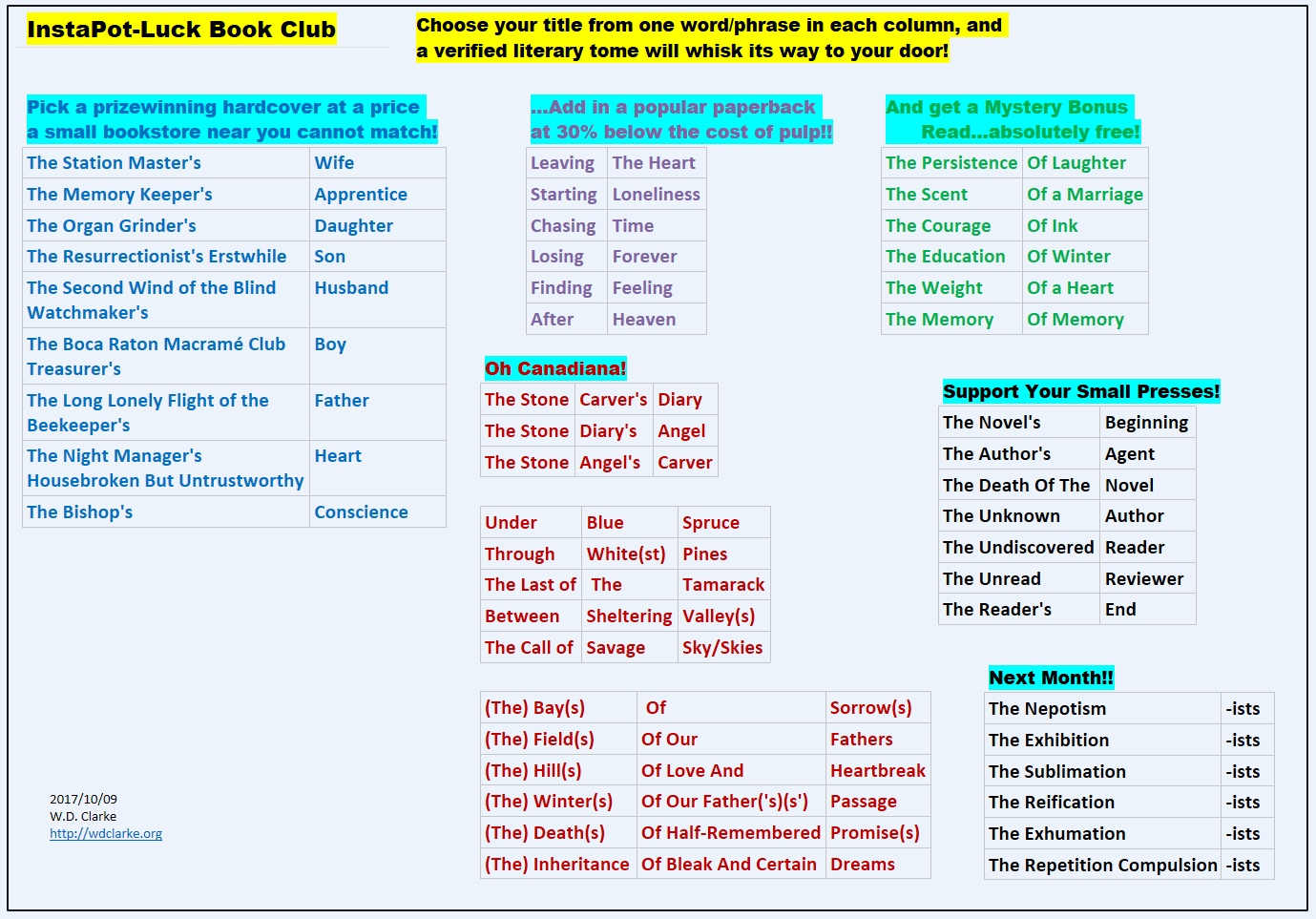
InstaPot-Luck Book Club

…


Mea Culpa (2017.02.21)

This transpired the other night….


…


Day of Atonement


…


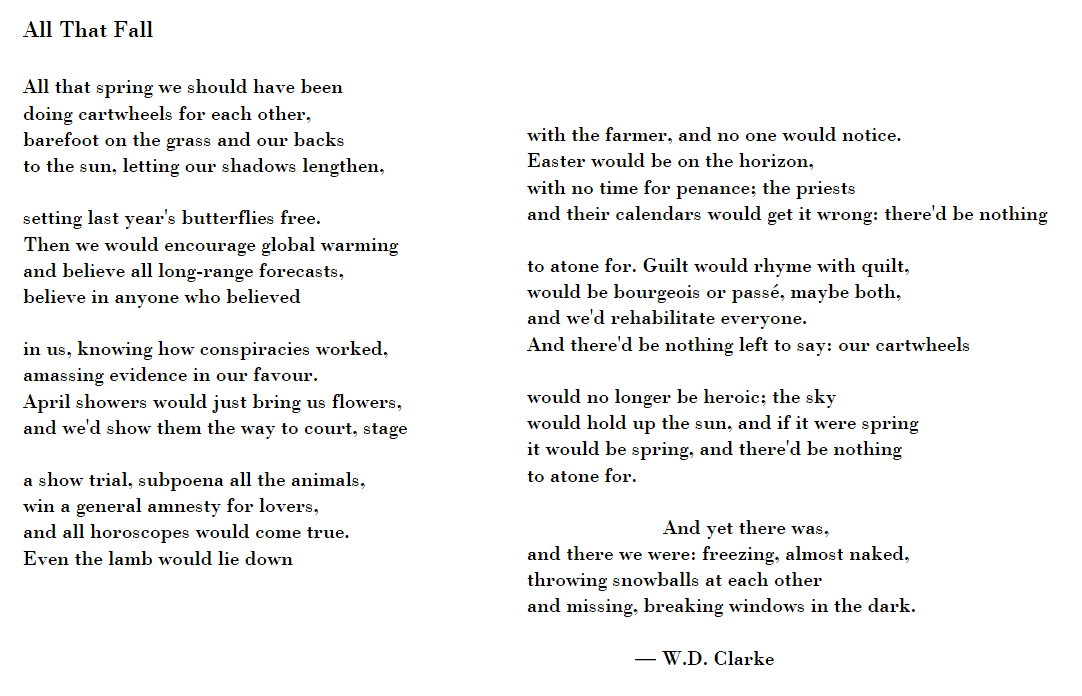
All That Fall

The title for this poem is taken from a Samuel Beckett play, which refers to Psalm 145, Verse 14:

The Lord upholdeth all that fall, and raiseth up all those that be bowed down

Click on the thumbnail below to view it properly, and if you like it, check out some of my other poetry!


…


Just After The Lunar Eclipse

Here’s a poem from the past, published by the now-defunct journal Ash (Kingston, Ontario, Canada) twenty years ago this month, back in 1996.  Click on the thumbnail below to read!

If you liked this poem, here’s another.

…


A Song From The Sea

I co-wrote a song with Morroccan Singer/Composer Oualid Ekami, who performs it here. It was originally inspired by an idea/feeling that The Waterboys’ song “This Is This Sea” has haunted me with for many years, and though I was initially trying for a Leonard Cohen/Nick Cave vibe lyrically, here Oualid performs this song with a lush, romantic arrangement and vocal that seems quite appropriate in retrospect.


And click on the following link to get a pdf of the lyrics:

Song From The Sea -WD Clarke Oualid Ekami 2016

…


Capitalism and its Discontents: On Benjamin Kunkel’s Utopia or Bust

I have written on the intersection of capitalism and literature in the past, and I’m intrigued about his project of giving the following thinkers (some of whom are more relatively unknown than others, especially to North Americans) a public hearing. So far, having finished the introduction and skipped to the “Further Reading” pages, I must say that I find his style to be engaging, personable, and forthright. Note:I will be adding reflections on each chapter of the book as I get to them — as of right now Chapters 1 and 2 are complete and can be found below.

Chapter 1: David Harvey

Kunkel locates the essence of Harvey’s work in the capitalist tendency to overaccumulate — “the fount of all crisis”, a word Harvey defines as “surplus capital and surplus labor existing side by side with seemingly no way to put them back together.” Investors sit on piles of cash, unwilling to put it into the hands of workers they won’t risk hiring, but upon whom the economy relies as consumers.

So far Harvey is depicted as assembling stray bits of Marx into a coherent picture of how, in “normal” circumstances, fictitious capital (credit), uses the promise of tomorrow’s profits to bridge today’s gap between a economy’s ability to pay its workers and the workers’ ability to consume what the economy produces. Thus always borrowing from the future imposes the GOD (Grow or Die) imperative on the economy.

Again,……


Sea-Glass Sonnet


…


Decomposition (poem)


…


Ask The Pessimist

[Misinspired by George Saunders’ “Ask the Optimist!“, which has also been turned into a puppet show [!!] that you can read about here and view here.]

Dear Dr. Pessimist,
Don’t you find pessimism “negative”?!
–Just Sayin! in Cincinnati

Dear Just,
Just think of me as helping you obey the first and second laws of thermodynamics. In the real world, not only is energy always conserved (as it can never be created or destroyed), but also: all natural systems (and hey check it out! you are one, too!) tend to go south as it were, towards maximum entropy, towards irreversible disorganization. Things fall apart, the centre cannot hold (you know the rest).

So as I see it, my job is to cancel you and your optimism out, so that nothing of you or of what you say remains, just a perfect, eternal nullity. No loss, no gain, nothing, nothing contained in nothing—just nothing, nothing at all.

Zilch, nada, nichts. Rien, niente, nanimo. Nothing.
–Just sayin!

*     *     *

Dear Dr. Pessimist,
Whenever I’m not distracted (which is not very often if I can possibly help it, and I always find Tumblr and its ilk quite useful in that regard) I sometimes catch my self almost admitting to myself (if not to others, since that would be social, not to mention career, suicide) that, yikes! I might, perhaps, be a pessimist too(?) But really: UGH! That’s a downer, verging on an outright bummer. Which is depressing, in-and-of-itself, if you……


Life North of 60 (poem)

This poem, featured in The Guardian’s poetry workshop back in 2007, takes a poke at conventional domestic arrangements…


A Poem for Marc Chagall

Here’s a poem inspired by (as the title says) an inadequate postcard reproduction of an amazing painting by Marc Chagall. It is a poem that couldn’t find a home in Canadian poetry journals, but I still think it deserves a reader or two.

Lines Written On The Back of a Shitty Postcard Reproduction of Chagall’s “Souvenir de ma Jeunesse” [Poem]: Click on the thumbnail below to read!

A few other poems of mine can be found here and here.

…


A Retort to Yeats: Contra “Leda and the Swan”

Yeats

“Leda and the Swan”, by WB Yeats, has inspired a poetic “retort” by a fictional character!

Pegeen Mike O’Flaherty, a character in my work-in-progress, The Death of the Author, is a famous Canadian novelist who was a feminist poet in the late 1960s, and who gives a lecture to an undergraduate class on the supposed failings of W.B. Yeats. Below you will find her poetic retort to “Leda and the Swan”, (“Leda Sings Nomans Pricksong”) published in her first collection –suitably (?) titled Penis Envy.

Click on the embedded picture below to get a much larger view:

“Leda and the Swan” is a masterful but disturbing sonnet about (among other things) the indifference of and masculine nature of history.  If you are new to the poem, or to Yeats, an excellent analysis can be found at aterriblebeautyisborn.com, along with discussions of a number of his poems. The epigraph to Pegeen Mike’s response poem comes from Eli Faure’s floridly written History of Art.

Finally here is another poem “by” Pegeen Mike, also dating from the late 1960s and dedicated to her alleged paramour, Leonard Cohen!

…


“Game Theory” —A Poem for Leonard Cohen

Leonard Cohen

I’ve long had a love affair with Leonard Cohen. And while my passion has been life-long and metaphorical, Pegeen Mike O’Flaherty, a fictional character in my work-in-progress, The Death of the Author, claims to have had a much more short-term and physical relationship with the poet, for whom she wrote this poem way back when. Dedicated to Leonard, “Game Theory” is from her now out of print first collection, Penis Envy (Kassandra Press, 1968).

Click on the thumbnail below to get a larger version of the poem!

Poems referenced in Pegeen Mike’s response can be found in Leonard Cohen’s Let Us Compare Mythologies (“Prayer for Messiah”) and The Spice Box of Earth (“As the Mist Leaves No Scar“), and can be previewed on Google Books.

Finally, another of Pegeen Mike’s poems — a retort to “Leda and the Swan” by WB Yeats– can be found here


…


8-Track (a short story)

Their cleaning lady rarely needed to do much to the Living Room. The Tibbs were certainly not slobs like the Mullaneys across the street, with their five half-clothed kids always mucking about and a different beater in the driveway every month. Yet neither were they as deathly fastidious as the Dobbins next door (never a light on in the place and mausoleum dustcovers atop anything that didn’t threaten to move or to breathe). No, the Tibbs family definitely kept to the Middle Way; theirs was a relaxed, inviting house, but one in which everything had—and knew—its place. The kitchen was clean and tidy, the boys’ bedrooms less so. The roles allocated to the Den, the main-floor Family Room and the basement Rec Room were self-evident, easily understood by (and accommodating to) their numerous visitors. Most dinner or overnight guests would agree, if compelled to respond to an exit poll on the subject, that the furnishings were, in the main, both comfortable and practical, neither pretentious nor vulgar, and symbolic, perhaps, of a shared—if largely unspoken—intimacy.

Such, at any rate, is what young Gerald Tibbs, 23, would later remember hearing himself telling himself. And: that though he had never felt comfortable in the Living Room, it was not something to which he had ever given much thought. Still, he warily, unconsciously kept his distance. No one else save Fluffy (the family cat, a white car-accident-Manx) ever seemed to bother or to dare to go in there. There was a badly out of……


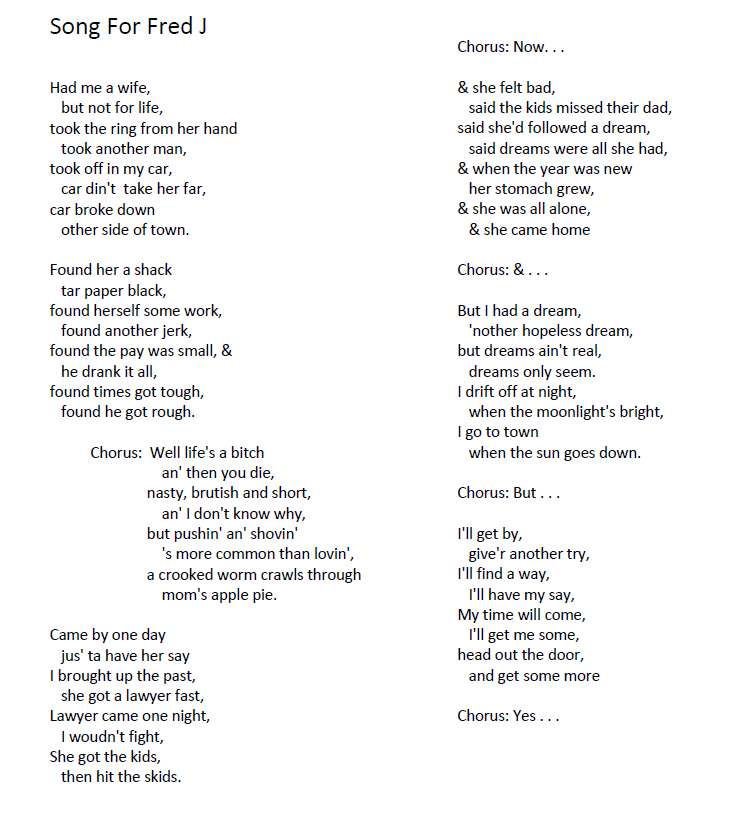
3 Songs For Fred J. Eaglesmith

Fred J. Eaglesmith. If you don’t already know him, you should.
He is one of Canada’s very finest songwriters, with the best of his lyrics subtly evoking a muted nostalgia for a hardscrabble past–for everything that’s been lost to us, or that we’ve chosen to ignore–and a gruff fathoming of what is often locked up tight in any human heart. Here is a recent video, “Johnny Cash”:

I have written him three songs–maybe one day I’ll even send them.
Click on the thumbnails below for larger versions.


…


A Polyphonic Spree: Notes on Milan Kundera’s The Art of the Novel

I have always been obsessed with Milan Kundera, and wanted to figure out why, so I grabbed his book The Art of the Novel, and sat down to take notes. What follows is my account of his account of why he writes the kind of books that he does.

ONE: The Depreciated Legacy of Cervantes

In 1935 the philosopher Edmund Husserl diagnosed a “crisis of European humanity”(3) by which he meant the very modernity that Europe bequeathed to the rest of the world, for good or ill. This modernity was a Cartesian quest to mathematize scientific knowledge, as well as a Faustian quest for knowledge-as-power, the personification of which is a rather virile scientist who seeks to “apprehend” and “interrogate” the world much as Kundera’s own character Tomas in ULB (The Unbearable Lightness of Being) wields a scalpel, both in his role as a surgeon as well as in his epic quest to conquer the infinite variety of women in the world. And just as such men reduce women to the status of objects, modernity for Husserl “reduced the world to a mere object of the technical and mathematical investigation and put the concrete world of life, die Lebenswelt [. . .] beyond their horizon. The result is that modernity began a process of the “forgetting of being”(4), the forgetting of what it means to be human (and thus the reduction of what it means to be human to the scientifically discoverable.

But for Kundera the modern era is an ambiguous one, marked……


Football & the Death of the Hero in “56-0” by TC Boyle

Smart lad, to slip betimes away
From fields where glory does not stay,
And early though the laurel grows
It withers quicker than the rose.
—“To An Athlete Dying Young” (A.E. Housman)

Robert Downey Junior’s character Derek Lutz (in Rodney Dangerfield’s Back to School (1986)) may well have been poaching, with tongue-in-cheek, from Don DeLillo’s End Zone when he quipped that “violent ground acquisition games such as football are in fact a crypto-fascist metaphor for nuclear war,” but TC Boyle takes Lutz’s (or Delillo’s) conceit up a notch or two in “56-0”, which I jealously think is one of the most perfectly crafted stories that I have ever read. “56-0” can be found in Boyle’s  Stories, but it was previously published in his 1992 collection Without a Hero, whose title is a perfectly apt controlling metaphor for the story as a whole, since, with seemingly effortless grace, Boyle has somehow managed not only to revivify one of American culture’s most clichéd of plotlines (an underdog team’s attempted, “against all odds” heroic “comeback”), but also to bring the ossified Aristotelian unities magically back to life, such that his story gains a remarkable, athletic equipoise,  in which  humour is locked into a dialectical deathgrip with existential gravitas. And—somehow—Boyle  manages to make writing like this appear to be the most natural thing in the world.

1. Life is Football (and Football is Life)

The main character of the story is Ray Arthur Larry-Pete Fontinot, who……


The Arc of Modernity: From Hamlet to Rosencrantz and Guildenstern Are Dead

The following is a little potted something that I give to my students when we are trying to puzzle out what it means to be ‘modern’, to work towards an understanding of what historical continuity connects  Hamlet to L20C works like The Unbearable Lightness of Being or Rosencrantz and Guildenstern Are Dead.

I include it here as an addendum to my previous post: before you go emailing me about how historically vulgar and Olympian it is, I’d just like to say that it is a bit, yes, vulgar and  Olympian, a bit of a caricature of intellectual history. But young students need to see history in such broad bush strokes to care about it at all, to feel it is relevant to their experience of the world as it feels like it stands now. I reproduce it here because, increasingly, I feel, a lot of contemporary literature has abandoned even this vestigial inkling of historical awareness.

So many writers today feel as if they can safely ignore the efforts of those who have written before us, those modernists hose who have wrestled with one or another version of this narrative: Joyce, Woolf, Beckett, Brecht, Borges, & etc, are now safely consigned to the dustbin of literary history, so easily forgotten in the search for the next Booker short list nominees. Writers today are free to write in any mode they choose, to write, even, as if 19C realism is in no way compromised or problematic. And yet……


What I’m Doing Here

Years ago, when I was a very lost first year undergrad, I had an inspiring professor named Dr. Tim McNamara (below) who succeeded at the near-impossible: at getting a motley collection of over-worked young engineering students and military cadets to pay attention in a dreaded, required freshman English survey course. The heft of the Norton Anthology of English Literature that we lugged to class along with our Optics, Mechanics and Chemistry texts, combined with the fragility of its 1000+ onion skin pages (as well as with the impenetrable density of its type), cast an ominous pall over the room as we slouched in our chairs awaiting not Infinite Jest, but  Infinite Boredom.

But Dr. McNamara won us over immediately. He did so by showing to us why (and how) Chaucer, Spencer, Milton, Donne, et al. were not just some random resinous garden gnomes who somehow stubbornly insisted upon persisting in the junk-yard of history. No sir! They were, rather, living and -yes- breathing distant relatives, the kind of knowing, naughty Uncle Wise Guys who would wink at you even as they declaimed some important weighty truth about the human condition, the uncles who would “playfully” slap you in the face in one of their “pretend” boxing……